
Testing gold
Which tests you can run to verify the gold content.
Gold is a precious metal, which makes it tempting to counterfeit. There are several ways to test whether something really is gold:
- Acid testing with a touchstone and solution. The gold is scratched on a stone and a drop of testing solution is applied to the scratch. This acid consists of concentrated nitric and hydrochloric acid; the ratio depends on the gold content being tested.
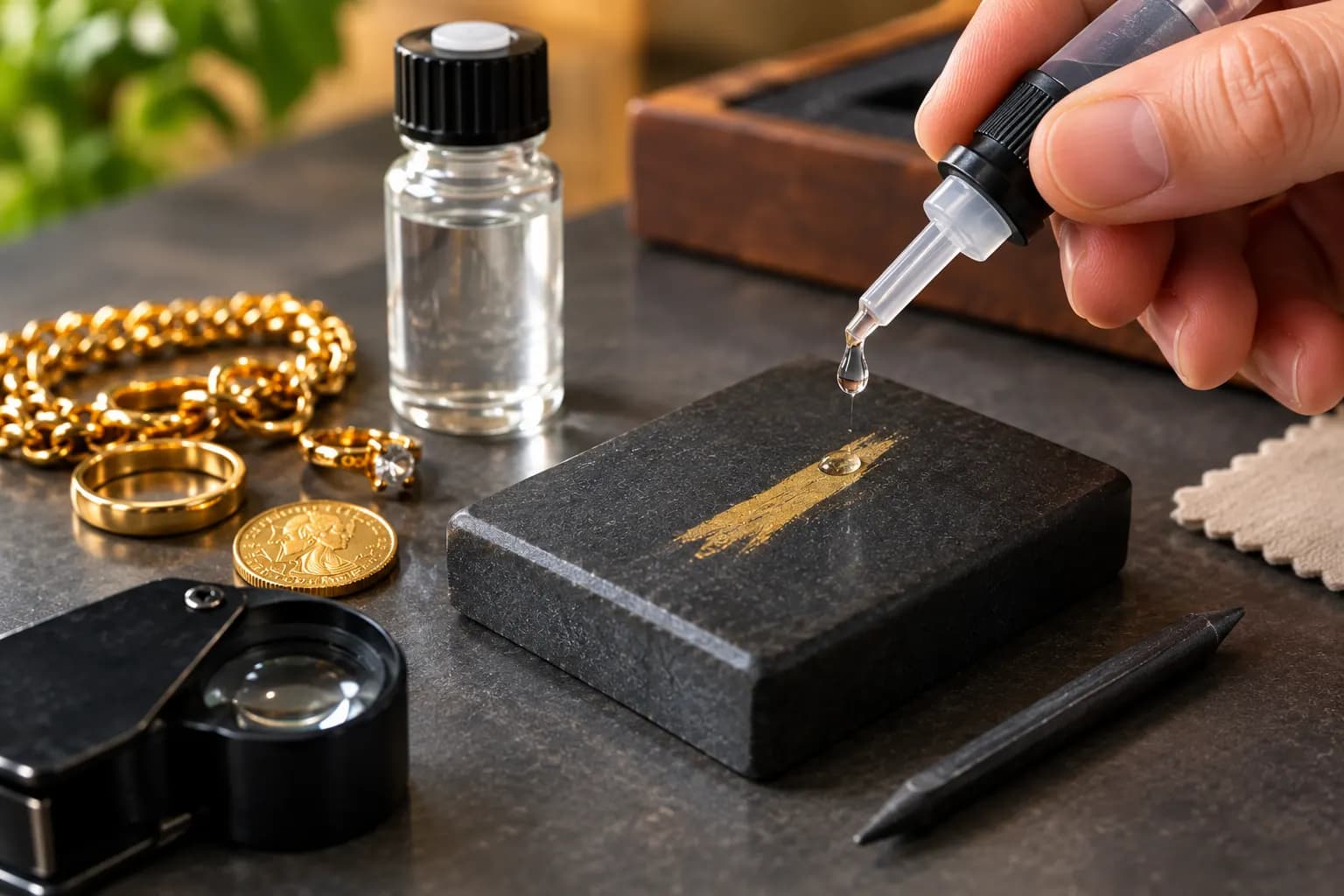
- Calculating the weight. A calculation tells you whether the weight of the object matches the gold content it claims.
- The Archimedes water test. A gold object is submerged in water. The displacement lets you calculate the specific gravity of the object.
Acid testing
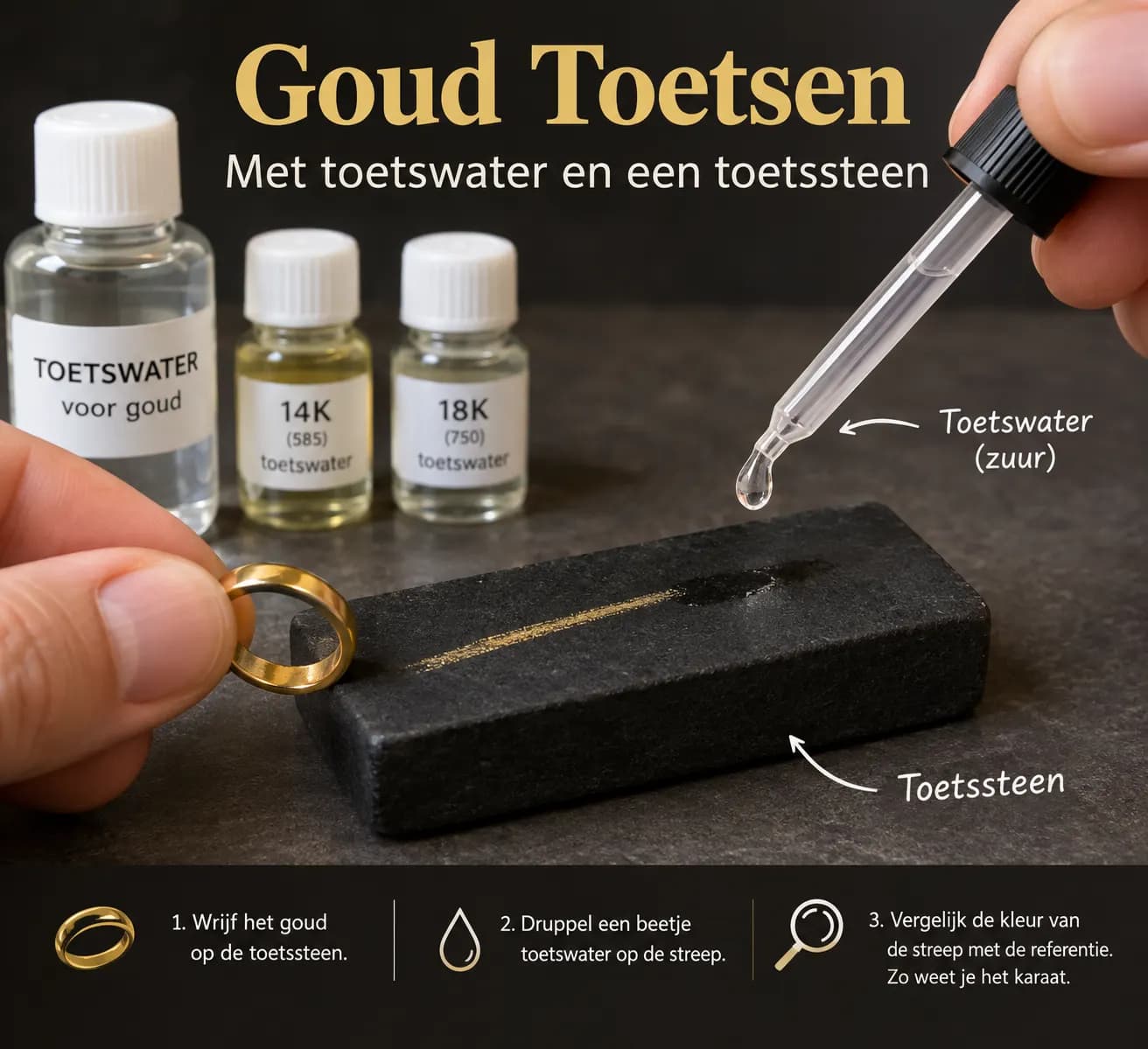
Before testing, it is worth examining the object closely. Does it feel like gold? Gold has a high specific gravity, so it should feel relatively heavy. Does the colour match other gold objects, or is it more coppery? Are there any marks? Many gold objects carry a hallmark, for example 585 (14 carat) or 750 (18 carat).
After making a few scratches on the touchstone, place a drop of testing solution on the scratch. If the object is marked 585, we use the 14 carat solution. If the scratch stays clearly visible, it is 14 carat gold. If it disappears immediately, within a few seconds, it is fake. If there are no marks, we again start with the 14 carat solution. If it holds, it is at least 14 carat gold. You can then repeat the test with 18 and 22 carat solution. If the scratch holds well, that is the content. If the scratch becomes a little less distinct straight away but does not disappear entirely, it may be a lower gold content.
Calculating the weight
Before we can determine the actual weight of an object, we first need to know the specific gravity of the gold alloy. Most gold in jewelry and objects is an alloy, meaning metals other than gold are present.
- Yellow gold = gold + ½ silver + ½ copper
- Red gold = gold + copper
- White gold before 1978 = gold + nickel
- White gold from 1978 = gold + palladium (alloy)
The specific gravity of the individual metals is known:
- Gold = 19.33 g/cm³
- Silver = 10.49 g/cm³
- Copper = 8.92 g/cm³
- Nickel = 8.908 g/cm³
- Palladium = 12 g/cm³
The specific gravity of the various gold alloys is in the table below. It can also be worked out with the following formula:
GC = gold content. SG = specific gravity in grams per cubic centimetre of the other material.
For yellow gold the formula differs, since it consists of three metals (gold, silver and copper):
| Alloy | 333 (8k) | 585 (14k) | 750 (18k) | 916 (22k) | 999.9 (24k) |
|---|---|---|---|---|---|
| yellow gold | 11.58 | 13.64 | 15.45 | 17.82 | |
| white gold (<1978) | 10.86 | 13.01 | 14.95 | 17.60 | |
| white gold (>1978) | 13.74 | 15.43 | 16.77 | 18.37 | |
| red gold | 10.87 | 13.02 | 14.96 | 17.61 | |
| pure gold | 19.33 |
Now we can determine the weight of chains and blocks of gold. The formula becomes:
A link chain has gaps between the links; you estimate those as the air volume.
Example 1
We have a yellow gold bracelet marked 14 carat. The dimensions are:
- Length = 19 cm
- Width = 25 mm
- Thickness = 2.5 mm
- Weight = 95 grams
- Air volume estimated at 7% of the total
From the table we take the specific gravity for 14 carat yellow gold: 13.64 g/cm³. The calculation is as follows:
If the bracelet really were 14 carat, it would weigh nearly 159 grams. Since our bracelet weighs only 95 grams, this is certainly a counterfeit.
Example 2
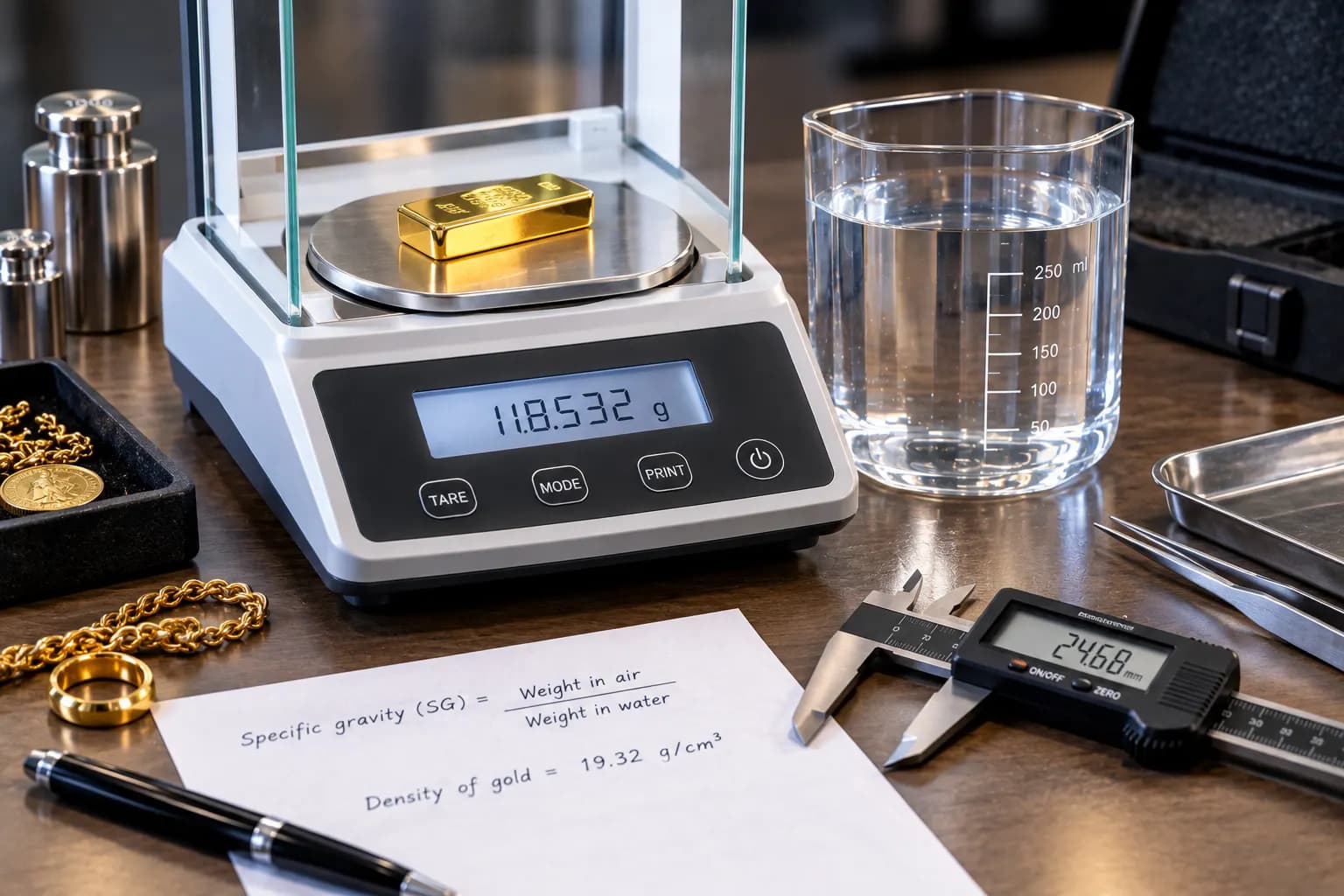
We have a stamped 100 gram gold bar. Dimensions:
- Length = 5 cm
- Width = 2.8 cm
- Thickness = 0.4 cm
- Weight = 100 grams
- Air volume = 0%
From the table we take the specific gravity of pure gold: 19.33 g/cm³.
Because the dimensions were measured approximately, the extra 8.25 grams is an acceptable difference. This gold bar is therefore very probably genuine.
Coins and medals
For coins and medals we can also calculate whether they are genuine. For this the volume of the coin has to be determined. One of the problems is that a coin has relief — an uneven height — which makes the thickness a little hard to establish. For a number of bullion coins the maximum thickness is known; for the calculation, however, we need the average thickness. If you have an unfamiliar coin, measure its thickness and subtract a percentage, somewhere around 20% or 0.5 mm.
We have a Canadian 50 dollar gold coin (1 ounce):
- Diameter = 30 mm
- Weight = 31.15 grams
- Thickness = 2.87 mm
- Gold content = 999.9 (24 carat)
Now we can determine the volume. The formula:
Volume
The volume of the coin is therefore 1.6752.
Once the volume is known, we can derive the specific gravity from it:
The specific gravity of the coin should be 19.33 (pure gold). In this case we can assume it is a genuine gold coin. The difference lies in the approximation of the average thickness — which should be 2.28 mm.
The average thickness of a coin can also be calculated. The formula is as follows:
If this were a counterfeit made of gilded silver, something in the proportions would not add up. In this case we assume the diameter and the weight were correct. First we calculate the volume:
And then we can determine the maximum thickness of the coin:
In this case the coin would therefore be almost twice as thick as an original gold coin.
Archimedes water test
Gold objects can also be tested using the Archimedes water test. Archimedes was a scientist of the 3rd century BC. King Hiero II came to him with a request to test a gold crown for authenticity. He was of course not allowed to damage the crown, and testing acid had not yet been invented. After long deliberation he arrived at the solution in his bath. Delighted, he jumped out and ran naked through the streets shouting “Eureka, eureka!” — I have found it, I have found it. What he had found is what we now know as the law of Archimedes:
The crown was first weighed normally, then weighed in a tub of water. He then divided the normal weight by the difference between the two weighings, which gave the specific gravity of the object. In this case it turned out to be a gilded silver crown.
Example
We have a yellow gold figurine that the seller declared to be 18 carat gold.
- The weight in air is 45 grams
- The dish of water weighs 183 grams
- The dish of water with the figurine (suspended from a spring) weighs 223.7 grams
We need no more data than that.
From this we can at least conclude that it is not gold. Most likely we are dealing with a silver figurine (10.49 g/cm³) that has been gilded. If this were an 18 carat gold figurine, the weight should be around 66.43 grams (4.3 × 15.45).
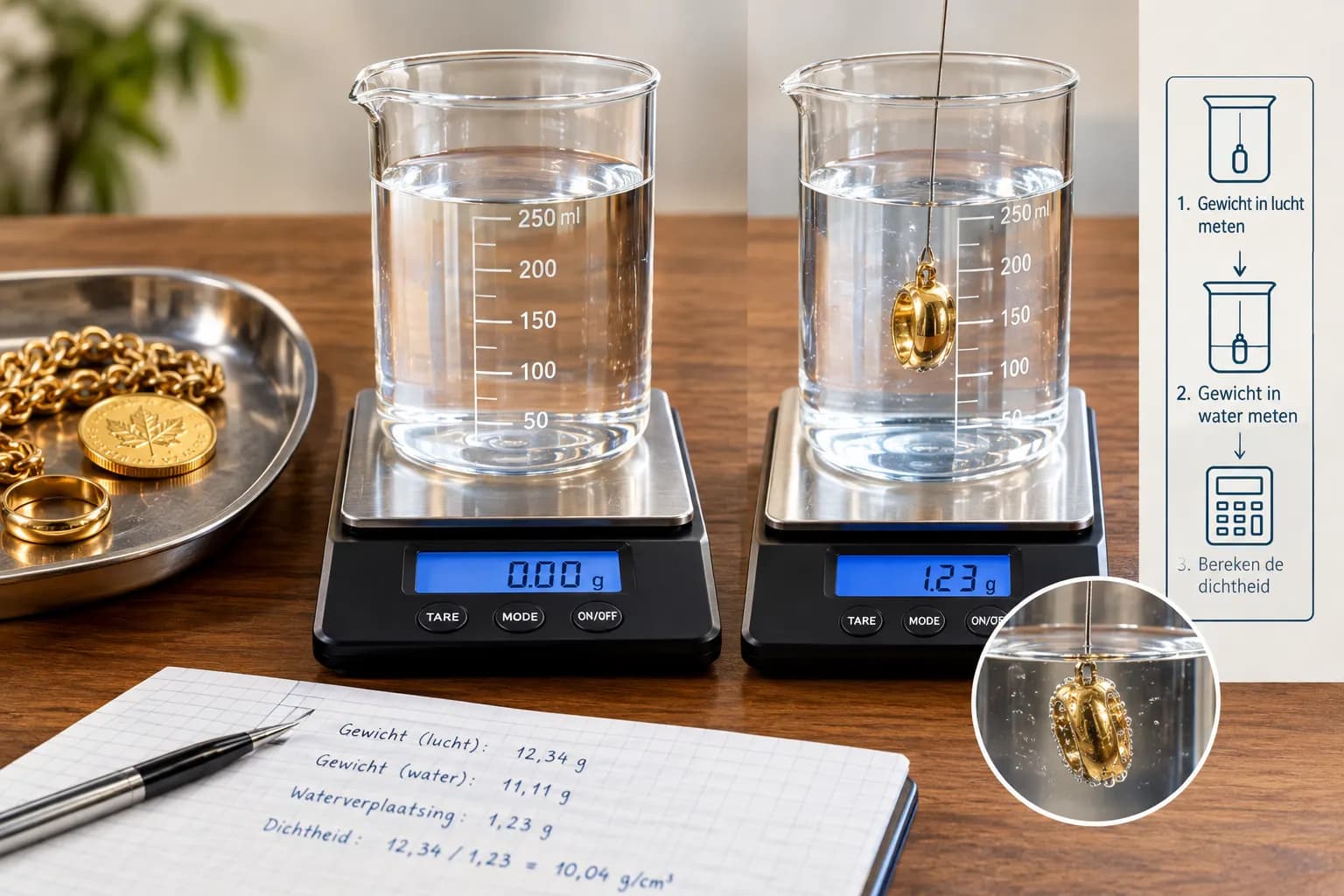
As an alternative to a scale you can use a spring balance. For smaller objects it is easier to use a glass measuring flask or beaker: divide the mass of the object by the water displacement in the flask, and that gives you the specific gravity of the object.
This page is general education, not a substitute for an in-person professional test at our shop.