Selling gold
What to watch out for when you want to sell gold.
The moment someone plans to sell their gold and wants to read up on it a little, they run into hundreds of websites carrying a good deal of contradictory information. You will also find plenty of posts warning against company X while praising company Y to the skies. Whether those are genuinely objective customer opinions, or a thinly veiled advert from the owner or an employee of company Y, is usually anybody’s guess.
Below are a few things a seller should keep in mind.
Prices on the internet
Searching online, you will find all sorts of different prices for gold. First of all this depends on the gold content (carat), which ranges from 8 to 24 carat. There are also clear differences between scrap gold and bullion coins and bars. That is because bars and coins are usually tradable immediately, while scrap gold first has to be processed back into a finished product — which naturally carries extra costs. The buyer also has to allow for the risk of a falling market and for melting loss. Browsing around, the prices you find for 14 carat gold (585) lie very far apart. How is that difference possible?
Cash versus trade-in price
If you want cash, you will generally get less than if you pick out new jewelry at the jeweller in question. The margins a jeweller normally has on new jewelry are considerable — several times the gold value of the piece — so they have plenty of room to negotiate.
Intrinsic value
You come across this term on some websites. The figure quoted is purely the value of the material. It is not an amount that gets paid out, but more of an informational value: it takes no account of margins, business costs, melting loss and so on.

Unclear costs and deductions
This is a somewhat murky area, where an amount promised by phone or online is talked down afterwards. Think of things like:
- A deduction for smaller quantities.
- Processing costs. Might these be administrative charges?
- A deduction for melting loss. This can knock several per cent off the weight in the calculation. The actual melting loss on gold is minimal — certainly compared with scrap silver — and should not be listed separately. It is something the buyer ought to allow for in the price offered.
- Testing and assessment costs. Although the smelter does ultimately have to charge for an assay, it is not customary to pass this on to the customer as an extra deduction.
- A deduction for gold not hallmarked in the Netherlands. In some countries the tolerances on gold content are a good deal wider than they are here. 14 carat gold means 585 parts gold per 1000 parts. The rest is silver and copper or nickel. In the Netherlands the maximum permitted deviation is 2 parts per 1000. With foreign gold this can be up to ten times that.
For an approximation of a reasonable price per gram for 14 carat (585), look at the Kitco rate (24 hour gold, price in euro per kilo). A little over half of that is gold. So divide it by 2, then by 1000 — from a kilo price to a gram price — and you arrive at an acceptable gram price for 14 carat. Anything far below that is not a good deal, and if you come across amounts far above it, you can assume those cannot be right either. Either they are not cash prices, or they are meant to lure you into the shop, where you end up confronted with a much lower figure anyway.

Sorting by carat
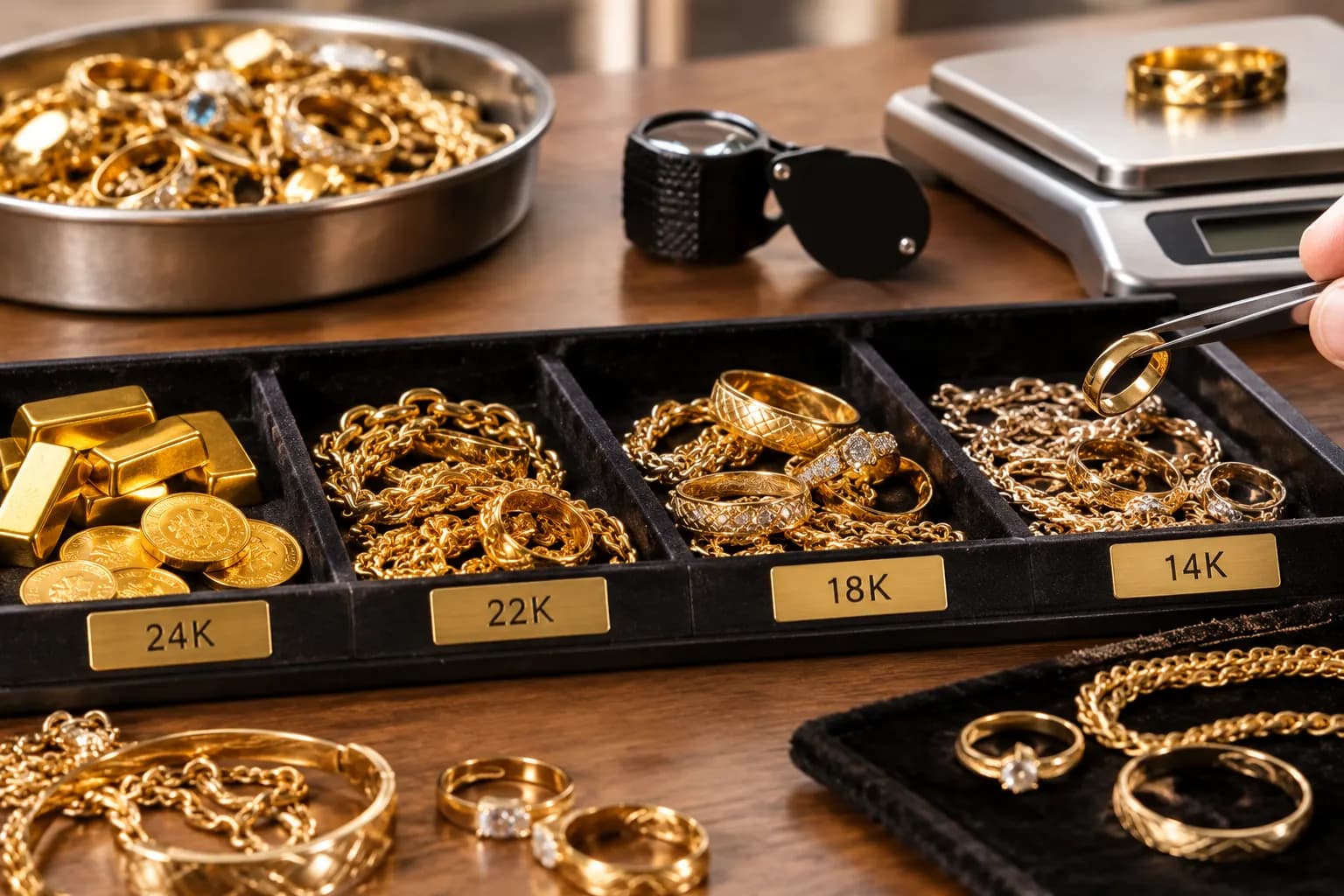
A batch of gold offered for sale may consist of pieces of different gold content. An honest buyer will sort this out neatly for you. But it is always a good idea to come prepared. Most jewelry is hallmarked, which already clears up some of the confusion. Here are some of the most common gold contents.
| Carat | Content | Note |
|---|---|---|
| 8 carat | 333 | 333 parts per 1000, so one third gold |
| 9 carat | 375 | |
| 10 carat | 416 | |
| 14 carat | 585 | |
| 18 carat | 750 | |
| 22 carat | 916 | |
| 24 carat | 999 |
There are a few other carats, but you rarely come across them. So if you find one of these numbers on a piece, you can assume that is the content. Just occasionally something is stamped wrongly — a ring stamped 585 that turns out to be 8 carat, for instance. This is easy to check with an acid test: you make a small scratch with the ring on a touchstone and place a drop of 14 carat solution on it. The scratch should fade noticeably straight away, until it is only faintly visible.
It is worth sorting some jewelry by carat in advance. For anything unclear, the buyer can then determine the content by acid testing — see also Testing gold. Judging gold content from colour differences is not an option: by varying additions such as red or yellow copper, the same gold content can come in different colours.
Dutch gold coins have a content of .900 (21.7 carat), so 900 parts gold per 1000. The most common are the gold ten and five guilder coins, and their weights are known: 6.72 grams for a ten and 3.36 grams for a five. It should be noted that a proportion of the tens (around 5%) and the great majority of the fives (around 95%) that have been worked into jewelry are restrikes in 14 or 18 carat, or even copper. If in doubt you can always have this verified by a coin dealer. Specifications for coins from other countries are easy to find online.
Deductions for other materials
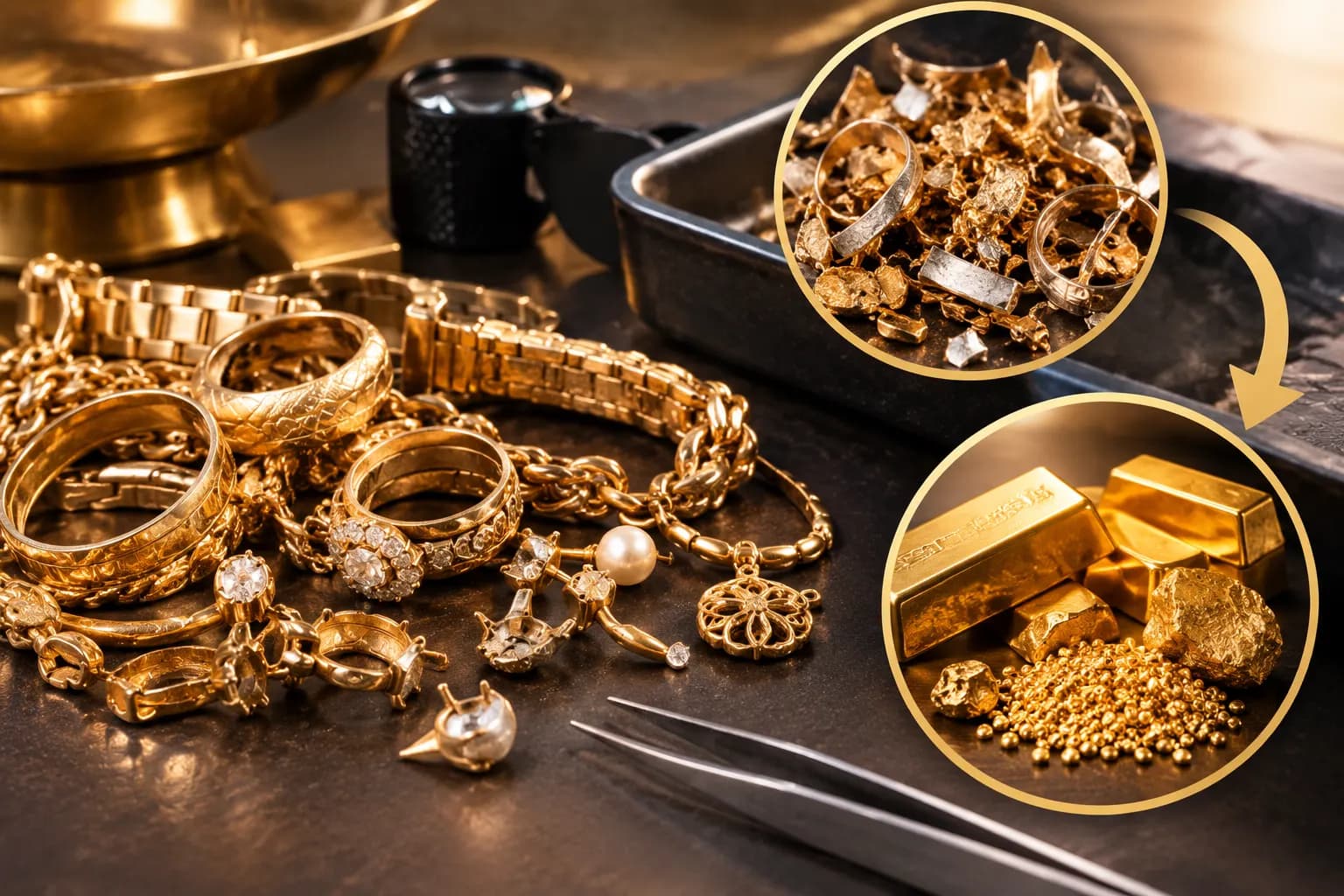
Jewelry is generally not handed in completely clean. Think of things like:
- Gemstones and semi-precious stones
- Filling inside slave bangles and signet rings (resin, plaster and so on)
- The glass and movement of watches. Contrary to what some sellers claim, these are not gold: gold is a naturally soft metal, too brittle for the job and it would wear out too quickly.
- Repairs to old jewelry using tin or other materials
- Other additions such as steel, leather and rubber
Normally an estimate of the other materials is made first. That gets you to an approximate price, which can still shift a little up or down. Estimating is largely a matter of experience, but a seller can work out an approximation of the residual weight in advance too.
Stones
If the carat of a brilliant is known, its weight is easy to calculate: 1 carat weighs 0.2 grams. So the total carats of brilliants × 0.2 gives the weight of the stones in grams. Since a lot of different stones and semi-precious stones are set into jewelry, with a different specific gravity — usually heavier — you are best off using total carats × 0.4 for an approximation. For an overview of the various shapes and sizes of stones, see this reference.
Slave bangles
To give slave bangles a bit more rigidity, they are sometimes filled with a kind of resin or plaster. You can tell whether a bangle has actually been filled by, for example, two small holes on the inside of the bangle near the hinge; these are used to inject resin with a needle. You can also check by pressing a pin into the opening of the bangle. Depending on the material used, this can account for a quarter to half of the total weight. Note: there are also bangles carrying both silver hallmarks (ZI/ZII/835/925) and gold hallmarks. These are usually silver with 14 or 18 carat gold plating, and so have to be counted as scrap silver.
Signet rings
Like some slave bangles, many signet rings contain a resin-like substance for rigidity. You can check this by pressing firmly on the inside of the ring. If there is any give, you can assume it is not a solid ring. The weight of stone and resin is roughly 2 to 4 grams, depending on the size.
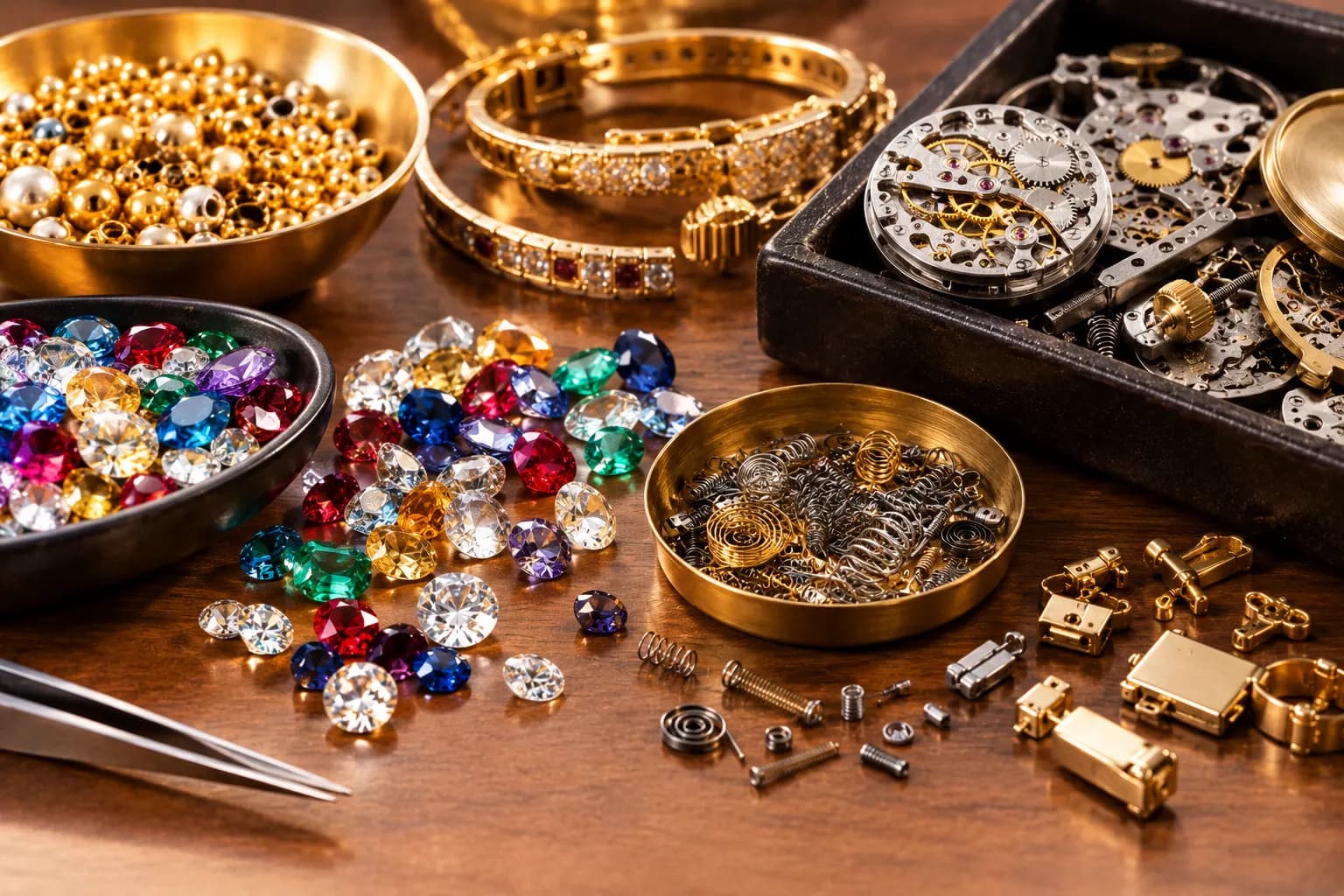
(Pocket) watches
Watches come in all shapes and sizes, so this is not so easy to pin down. For a reasonable estimate you can work with the following:
- Small ladies’ watches: glass and movement weigh roughly 3 to 4.5 grams.
- Small ladies’ pocket watch: roughly 3 to 5 grams of gold.
- Men’s automatic watch: roughly 15 to 20 grams of movement and glass.
- Men’s pocket watch: roughly 7 to 20 grams of gold.
- Imitation men’s Rolex: roughly 23 grams of movement and glass. On an original this is roughly 30 to 40 grams.
- Men’s quartz watch (Prestige or Genève, for example): roughly 10 grams of movement and glass.
These are approximations only. If you intend to sell jewelry with residual materials, or a watch, it is worth having it broken down first and then weighed again.
Weighing
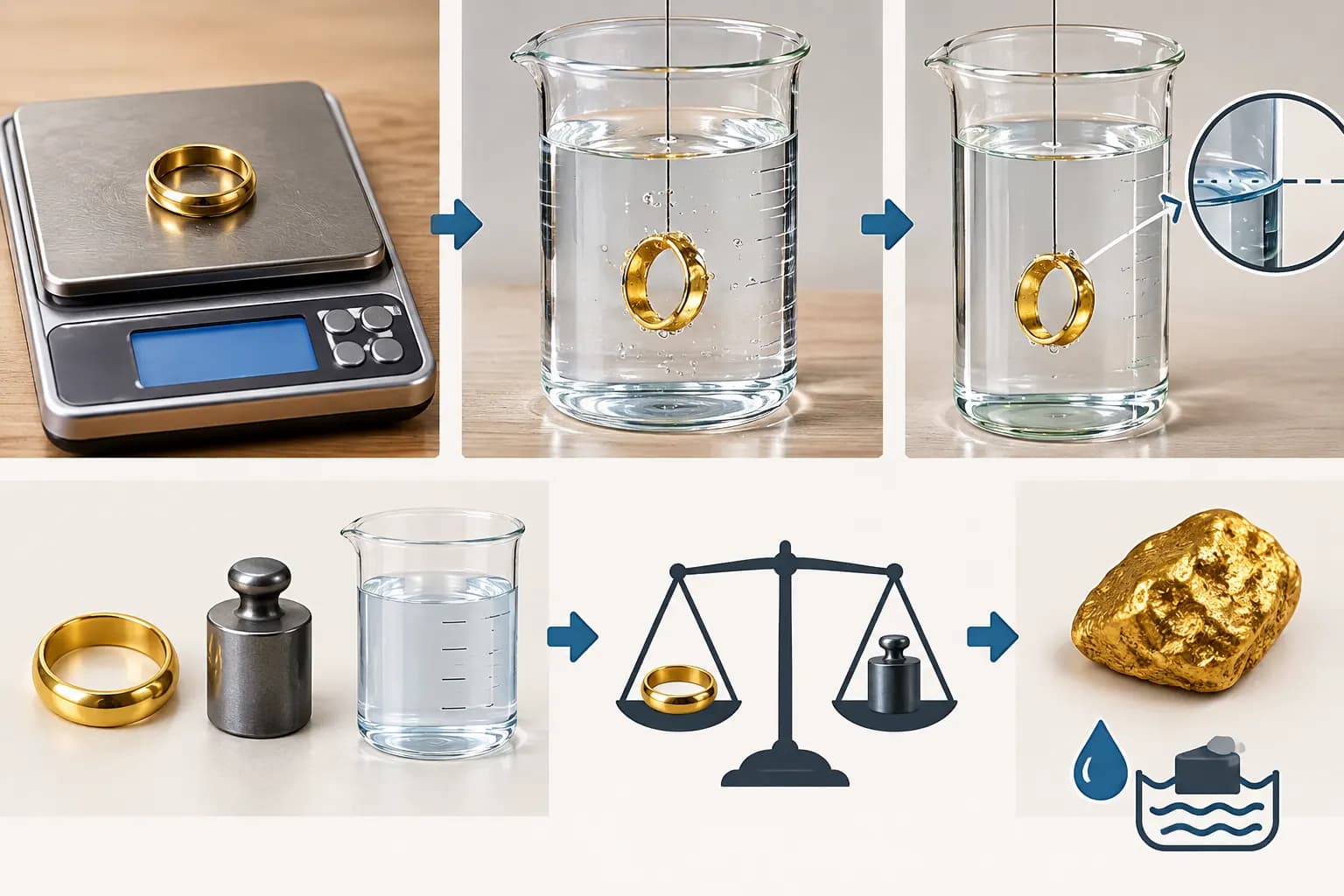
Once everything has been sorted by carat and the weight of residual materials is known, the gold can be weighed. You can weigh some of it at home on a kitchen scale for a rough estimate, but those deviate too much to give a proper picture. Every gold dealer is required to use a calibrated scale. In practice, cheap uncertified scales are used a great deal. You can recognise a calibrated scale by the stickers usually found on the side of the device. Among them will be a sticker from Verispect, which supervises compliance with the Metrology Act.
Generally it is only decent that the seller can see the scale’s display and watch while the weighing happens. If you intend to visit a few other places to compare prices, it is useful to note the exact weights from a calibrated scale. If another company arrives at a lower weight, it is immediately clear that they are not a trustworthy address.
At the end of the day, both parties should come away feeling good about the transaction.
- Have you heard good things about the company through others? Remember: bad news travels fast.
- Is it not some shady back-street shop?
- Does the buyer come across as professional and trustworthy?
- Is everything sorted and explained properly?
- Is the weight of residual material recorded properly?
- Is the scale calibrated?
- Can you watch while it is weighed?
- Is it clear what you get per gram and how the total price was arrived at?
- Would you recommend that company to family or friends as a trustworthy address?